



来源于:雨露肝霖
根据最新数据显示,我国约有 7500 万 HBV 感染者 1,其中约 30% - 50% 的患者处于「不确定期」(又称「灰区」)2-6,据此估算,我国不确定期慢乙肝患者约有 2500 万人,数量庞大。在全球扩大抗病毒治疗的背景下,我国慢性乙型肝炎防治指南(2022 年版)7 和美国 AASLD/IDSA 慢乙肝治疗指南 2025 年版 8 均建议不确定期慢乙肝患者可适时接受抗病毒治疗。
近期,多项研究聚焦了不确定期慢乙肝患者的远期肝癌风险及抗病毒治疗获益,指出不确定期慢乙肝患者的肝癌风险较高 9,10,汇总肝癌年发生率为 0.32%11,部分不确定期患者的肝癌风险甚至高于免疫耐受期和非活动期患者 12;而抗病毒治疗是降低肝癌风险的有效措施,可显著降低 60%-70% 的肝癌风险 10,11,13。基于相关研究,肝霖君将用 3 张图帮助大家看懂不确定期慢乙肝患者的肝癌风险分层与抗病毒治疗获益。
图 1:精准识别肝癌高风险的不确定期慢乙肝患者
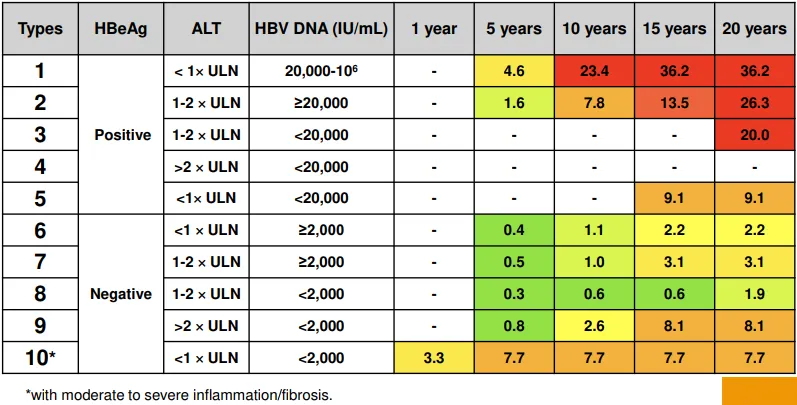
基于 2018 AASLD 指南,不同亚型不确定期慢乙肝患者的肝癌累积发生率(%)11
一项国际多中心队列研究 11 纳入 1986 例不确定期慢乙肝患者,根据 AASLD 2018 指南将不确定期慢乙肝患者分为 10 种亚型,结果显示各亚型不确定期患者的肝癌风险差异显著,并精准识别出 1、2、9、10 型不确定期患者的肝癌风险较高,20 年肝癌累积发生率分别为 36.2%、26.3%、8.1% 和 7.7%。此外,3 型不确定期患者的 20 年肝癌累积发生率也高达 20%,尽管因为患者数较少未明确 10 年和 15 年的肝癌累积发生率,但对于该类人群的远期肝癌风险也应予以重视。
图 2:不同年龄段不确定期慢乙肝患者的肝癌风险及抗病毒治疗获益
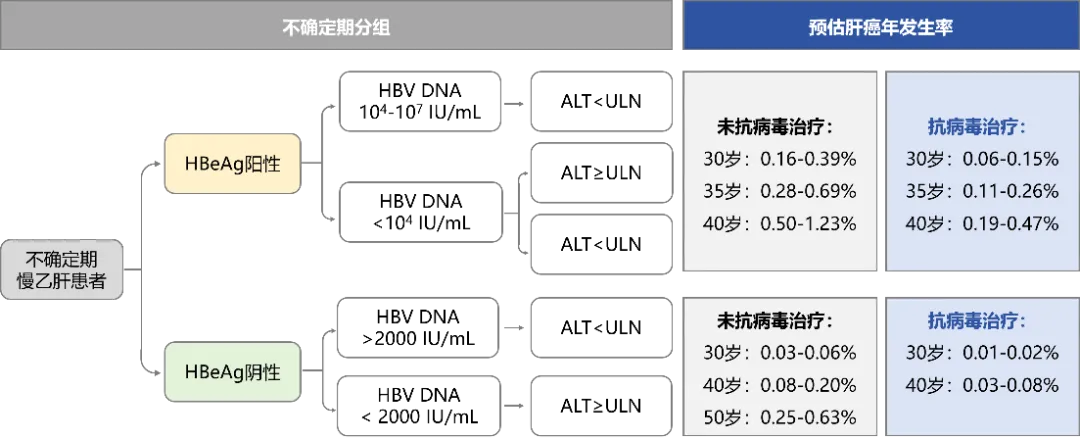
基于 EASL 2017 版指南,不同年龄段的不确定期患者治疗 vs. 未治疗的预估肝癌年发生率(截图)13
既往研究表明,年龄是不确定期慢乙肝患者疾病进展的独立危险因素 14,15,Lai 等 13 发表的荟萃分析也汇总了不同年龄段患者的肝癌年发生率,证实年龄越大,肝癌风险越高;而抗病毒治疗可显著降低各个年龄段不确定期慢乙肝患者的肝癌风险。
图 3:高危不确定期慢乙肝患者抗病毒治疗可显著降低肝癌风险
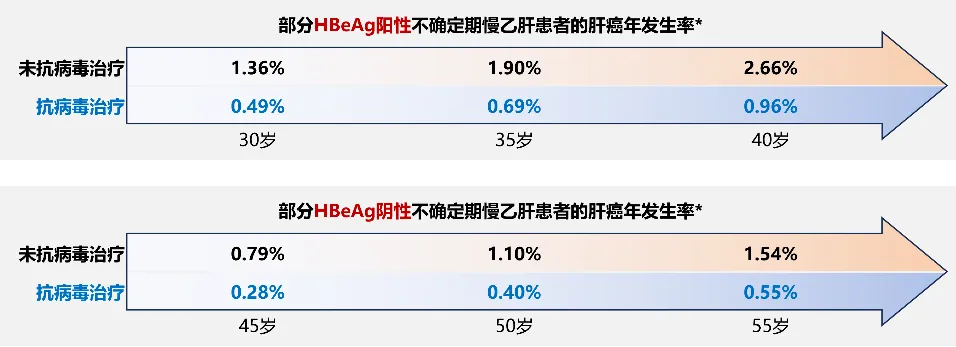
部分 HBeAg 阳性/阴性不确定期患者未治疗 vs. 治疗的预估肝癌年发生率
(*注:该发生率基于 Lai 等 13 的元回归分析结果,设定男性占比 60%、血小板计数 180×109/L)
既往研究显示,HBeAg 阳性 10、男性 10、血小板计数较低 5 与不确定期慢乙肝患者更高的肝癌风险相关。Lai 等 13 发表的荟萃分析证实了上述研究结论,且伴有上述风险因素的高危不确定期慢乙肝患者接受抗病毒治疗可更显著地降低肝癌风险,如在血小板计数较低(180×109/L)的患者中,40 岁的 HBeAg 阳性和 55 岁的 HBeAg 阴性不确定期患者未抗病毒治疗时的肝癌年发生率可达 2.66% 和 1.54%,抗病毒治疗后肝癌年发生率分别降至 0.95% 和 0.55%,提示该类高危不确定期患者积极抗病毒治疗的必要性和迫切性。
上述三张图清晰地呈现了不确定期慢乙肝患者的肝癌风险分层图谱以及抗病毒治疗的显著获益。年龄增大、HBeAg 阳性、血小板降低是识别高风险人群的重要指标,抗病毒治疗可降低不确定期慢乙肝患者的肝癌风险,且高风险者获益或更大。
慢乙肝患者获得 HBsAg 清除是降低肝癌等不良事件的有效策略 16,17。在此基础上,如何进一步优化抗病毒治疗策略,提高不确定期慢乙肝患者的 HBsAg 清除率,正是临床关注的热点难点问题。有研究表明,以聚乙二醇干扰素α-2b 为基础的方案可显著降低不确定期患者的 HBsAg 水平 18,有望帮助不确定期患者更快获得更高比例的 HBsAg 清除率,进一步降低远期肝癌风险。
参考文献:
1. Hui Z, Yu W, Fuzhen W, et al. New progress in HBV control and the cascade of health care for people living with HBV in China: evidence from the fourth national serological survey, 2020[J]. Lancet Reg Health West Pac. 2024, 51: 101193.
2. Xu X, Wang H, Shan S, et al. The Impact of the Definitions of Clinical Phases on the Profiles of Grey-Zone Patients with Chronic Hepatitis B Virus Infection[J]. Viruses. 2023, 15(5): 1212.
3. Ju Y, Han G, Zhang P, et al. Staging and clinical characteristics of pregnant women with chronic hepatitis B virus infection: A retrospective cohort study from Nanjing, China[J]. J Obstet Gynaecol Res. 2023, 49(10): 2427–2435.
4. Yu HS, Jiang H, Li MK, et al. Lowering the threshold of alanine aminotransferase for enhanced identification of significant hepatic injury in chronic hepatitis B patients[J]. World J Gastroenterol. 2023, 29(35): 5166–5177.
5. Huang DL, Cai QX, Zhou GD, et al. Liver histological changes in untreated chronic hepatitis B patients in indeterminate phase[J]. World J Hepatol. 2024, 16(6): 920–931.
6. Lin W, Ding R, Sun S, et al. Liver histological study of patients with chronic hepatitis B virus infection in the grey zone[J]. BMC Infect Dis. 2025, 25(1): 385.
7. 中华医学会肝病学分会, 中华医学会感染病学分会. 慢性乙型肝炎防治指南(2022 年版)[J]. 中华肝脏病杂志, 2022, 30(12): 1309-1331.
8. Ghany MG, Pan CQ, Lok AS, et al. AASLD ISDA Practice Guideline on treatment of chronic hepatitis B[J]. Hepatology. 2026, 83(4): 974–997.
9. Hui VW, Wong GL, Dai J, et al. Increased risk of HCC in HBeAg-negative indeterminate phase compared with HBeAg-negative chronic infection[J]. Hepatology. 2026, 83(1): 156–168.
10. Huang DQ, Tran A, Yeh ML, et al. Antiviral therapy substantially reduces HCC risk in patients with chronic hepatitis B infection in the indeterminate phase[J]. Hepatology. 2023, 78(5): 1558–1568.
11. Huang R, Trinh HN, Yasuda S, et al. Differential HCC risk among HBV indeterminate types at baseline and by phase transition[J]. Gut. 2025, 74(11): 1873–1882.
12. Spradling PR, Xing J, Rupp LB, et al. Distribution of disease phase, treatment prescription and severe liver disease among 1598 patients with chronic hepatitis B in the Chronic Hepatitis Cohort Study, 2006-2013[J]. Aliment Pharmacol Ther. 2016, 44(10): 1080–1089.
13. Lai JC, Wong GL, Tse YK, et al. Histological severity, clinical outcomes and impact of antiviral treatment in indeterminate phase of chronic hepatitis B: A systematic review and meta-analysis[J]. J Hepatol. 2025, 82(6): 992–1003.
14. Huang DQ, Li X, Le MH, et al. Natural History and Hepatocellular Carcinoma Risk in Untreated Chronic Hepatitis B Patients With Indeterminate Phase[J]. Clin Gastroenterol Hepatol. 2022, 20(8): 1803–1812.e5.
15. Wang J, Zhu L, Zhang Z, et al. Lower HBV DNA level is associated with more severe liver fibrosis in HBeAg-positive chronic hepatitis B with normal alanine transaminase[J]. Virol J. 2024, 21(1): 127.
16. Vittal A, Sharma D, Hu A, et al. Systematic review with meta-analysis: the impact of functional cure on clinical outcomes in patients with chronic hepatitis B[J]. Aliment Pharmacol Ther. 2022, 55(1): 8–25.
17. Deng W, Hao H, Zhang Z, et al. Clinical outcomes after HBsAg clearance in chronic hepatitis B patients treated with Peg-IFN α: A study with an 11- to 173-month follow-up[J]. Virol Sin. 2025, 40(4): 579–586.
18. Liu M, Zhang YT, Zuo LL, et al. Peginterferon Alfa-2b Plus TDF Treatment of HBeAg-negative Chronic Hepatitis B Patients in Indeterminate Phase: A Pilot, Open-Label, Prospective Cohort Study[J]. AASLD2023, Abstract (1435-C).
好文章,需要你的鼓励